
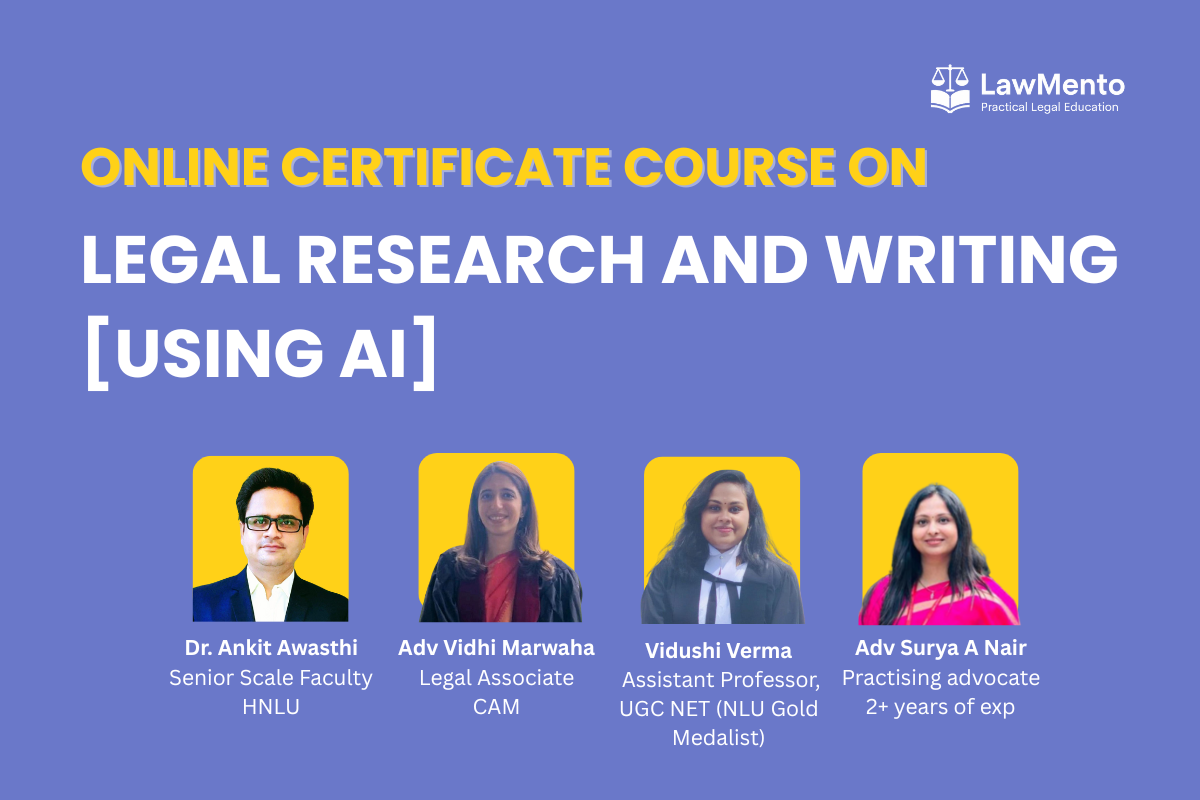
Legal Research and Writing Course Using AI
Learn how to identify legal issues, find reliable judgments, use citations correctly and prepare structured legal writing through an online legal research and writing course—with the responsible support of AI tools.
Why Legal Research and Writing Matter
Legal knowledge becomes useful only when a learner can locate the applicable law, evaluate the authority and explain the conclusion clearly. This online legal research and writing course builds that complete process. As an online certificate course on legal research and writing, it connects research methods, writing structure and responsible technology use.
Legal research and writing support almost every academic and professional legal task, including assignments, research papers, moot memorials, internship work, case preparation and written submissions.
Many learners still struggle to identify reliable sources, find relevant judgments, use citations correctly and verify AI-generated information. This online course on legal research and writing provides a clear process from topic selection to structured legal writing.
Common Problems This Course Addresses
- Difficulty framing a focused legal research question
- Uncertainty about reliable legal sources
- Weak case-law and citation searches
- Information overload and conflicting judgments
- Poor research-paper structure
- Unverified AI-generated cases and citations
Skills Learners Can Develop
The legal research and writing online course focuses on repeatable skills that may be applied to academic assignments, internships, litigation research, legal content and professional writing.
Frame Research Issues
Narrow a broad subject, identify the central legal problem and develop a focused, researchable question.
Find Reliable Sources
Locate relevant judgments, statutory material, official reports and dependable secondary sources.
Search Case Law
Use legal issues, provisions, party names, phrases and citations to locate and refine relevant judgments.
Organise Research
Arrange authorities and notes by issue, argument, theme and relevance for easier analysis and writing.
Write Clearly
Structure introductions, arguments, analysis and conclusions in clear and readable legal language.
Use Citations
Understand footnotes, references, bibliographies, consistent attribution and citation verification.
Verify AI Output
Cross-check AI-generated judgments, propositions and citations against reliable legal sources.
Explore Opportunities
Understand how these skills apply to publishing, research careers, legal content and freelancing.
Build a Reliable Legal Research Process
Get practical training, citation guidance, AI-use ethics and one-year course access.
Designed for Learners Across the Legal Field
Law Students
For assignments, research papers, moot memorials, case comments, journals and internship work through a legal research and writing course online.
Recent Graduates
For graduates preparing to enter litigation, law firms, academia, legal media or policy work through a legal research and writing online course.
Lawyers and Advocates
For professionals seeking an advanced legal research and writing course with efficient digital research and clearer writing methods.
Academic Researchers
For learners working on dissertations, theses, journal articles and research projects through an online certificate course on legal research and writing.
Legal Content Writers
For writers who need accurate source verification, structure, citations and readable explanations from an online course on legal research and writing.
Freelance Researchers
For individuals interested in research assignments, legal editing and independent writing work through a legal research and writing course online.
Legal Research and Writing Course Curriculum
The modules are placed inside expandable sections so the page remains easy to scroll. Learners can open only the topics they want to explore.
Module 1: Introduction to Legal Research and Writing
Understand the relationship between research, legal analysis and writing. The module introduces how these skills are used in law school, litigation, law firms, policy work, academic research and legal publishing.
Module 2: What Is Legal Research?
Learn the meaning and scope of legal research, including how a researcher identifies a legal question, locates relevant authority and develops a reasoned conclusion.
Module 3: Importance of Legal Research
Understand how research helps identify applicable statutes and precedents, supports arguments, prevents inaccurate statements and reveals changes in the legal position.
Module 4: Types of Legal Research
Receive an introduction to doctrinal, non-doctrinal, comparative, analytical, historical and empirical research approaches and when they may be used.
Module 5: Legal Research Using AI – Practical Training
This core practical module connects conventional legal research with responsible technology use.
- How to choose the right legal topic
- How to use Indian Kanoon for legal research
- How to use Digital Supreme Court Reports
- How to find Law Commission reports
- How to use Google Search to find reliable legal sources
- How to search for case law using legal citations
- How to use AI for preliminary research without treating it as an authority
- How to verify AI-generated cases, quotations and citations
Module 6: Key Challenges in Legal Research
Study common problems such as outdated authorities, conflicting judgments, incomplete online material, inaccessible sources and information overload.
Module 7: Understanding Legal Writing
Learn the qualities of effective legal writing: clarity, precision, logical organisation, appropriate use of authority, objectivity and consistency.
Module 8: Writing Legal Research Papers and Responsible AI Use
- Selecting and refining a topic
- Preparing a research outline
- Framing research questions
- Writing the introduction, analysis and conclusion
- Using judgments and authorities
- Editing, proofreading and avoiding plagiarism
- Understanding how AI should not be used in academic work
Module 9: PhD Thesis and Dissertation Writing
Explore topic selection, research objectives, literature review, methodology, chapter planning, source management, referencing and revision.
Module 10: References and Citations
Understand the purpose of citations, footnotes, references and bibliographies, along with the need to verify every source and AI-generated citation.
Module 11: Publishing Legal Research
Learn how to identify suitable journals, review submission guidelines, prepare a manuscript, check citations and respond to editorial comments.
Module 12: Career Options in Research
Explore applications in academia, policy organisations, think tanks, law firms, litigation chambers, legal media, corporate legal teams and research assistantships.
Module 13: Freelancing in Legal Research
Understand common freelance assignments, client expectations, timelines, originality, confidentiality, source verification and professional ethics.
Bonus: 500+ Legal Research Topics
Receive a bonus resource containing more than 500 topic ideas for articles, research papers, dissertations, assignments and independent study.
Practical Research Resources Covered
Indian Kanoon
Search judgments using keywords, provisions, party names and legal issues.
Digital Supreme Court Reports
Understand how to locate and use official Supreme Court judgment material.
Law Commission Reports
Find material relevant to legislative history, reform and policy reasoning.
Google Search Techniques
Use precise terms, quotation marks and domain filters to improve results.
Use AI as Support, Not as Legal Authority
The advanced legal research and writing course explains both the productive uses and the serious risks of AI-assisted legal work.
AI May Help With
- Brainstorming possible topics
- Generating preliminary keywords
- Creating a basic outline
- Organising notes and headings
- Simplifying difficult sentences
- Reviewing grammar and readability
- Developing questions for deeper research
AI Should Not Be Used To
- Rely on unverified judgments or citations
- Replace reading primary legal sources
- Submit generated academic work as original
- Quote statutes without checking official text
- Share confidential client information
- Copy content without analysis or attribution
- Replace independent legal reasoning
Use AI Responsibly in Legal Work
Learn practical research methods while verifying cases, citations and legal propositions through reliable sources.
Everything Learners Receive
Structured Learning
10+ hours of lessons covering research foundations, practical platforms, legal writing, citations, publishing and careers.
Practical Demonstrations
Step-by-step guidance on case-law searches, research platforms, topic selection and online source discovery.
Study Resources
6+ reading materials and a bonus list of 500+ legal research topics.
One-Year Access
Revisit the course lessons and practical demonstrations for one year.
Certificate
Receive a LawMento certificate of completion after completing the course requirements.
Immediate Access
Course access details are sent to the registered email after successful payment.
Meet the Mentors

Dr. Ankit Awasthi
With 10+ years of academic and research experience, Dr. Awasthi serves as Head of the Centre for WTO & WIPO Studies at HNLU and has guided research projects and publications.

Adv. Vidhi Marwaha
A Legal Associate at Cyril Amarchand Mangaldas, she brings corporate and commercial law experience from leading firms including SAM and IndusLaw.

Ms. Vidushi Verma
An Assistant Professor of Law, UGC-NET qualified and LLM Gold Medallist from NLU Odisha, with prior corporate legal experience at HDFC Limited.

Adv. Surya A. Nair
She brings professional experience in litigation, academic mentoring, moot court activities and practical courtroom research and drafting.
Where These Skills Can Be Used
Before and After the Course
| Before Taking the Course | After Completing the Course |
|---|---|
| Unsure where to begin research | Understands a structured research process |
| Depends on broad Google searches | Uses focused legal search techniques |
| Struggles to locate relevant cases | Understands issue-based and citation-based searches |
| Uses AI without verification | Understands responsible AI-assisted research |
| Finds it difficult to organise findings | Can prepare outlines and arrange authorities |
| Is confused about references | Understands citations, footnotes and bibliographies |
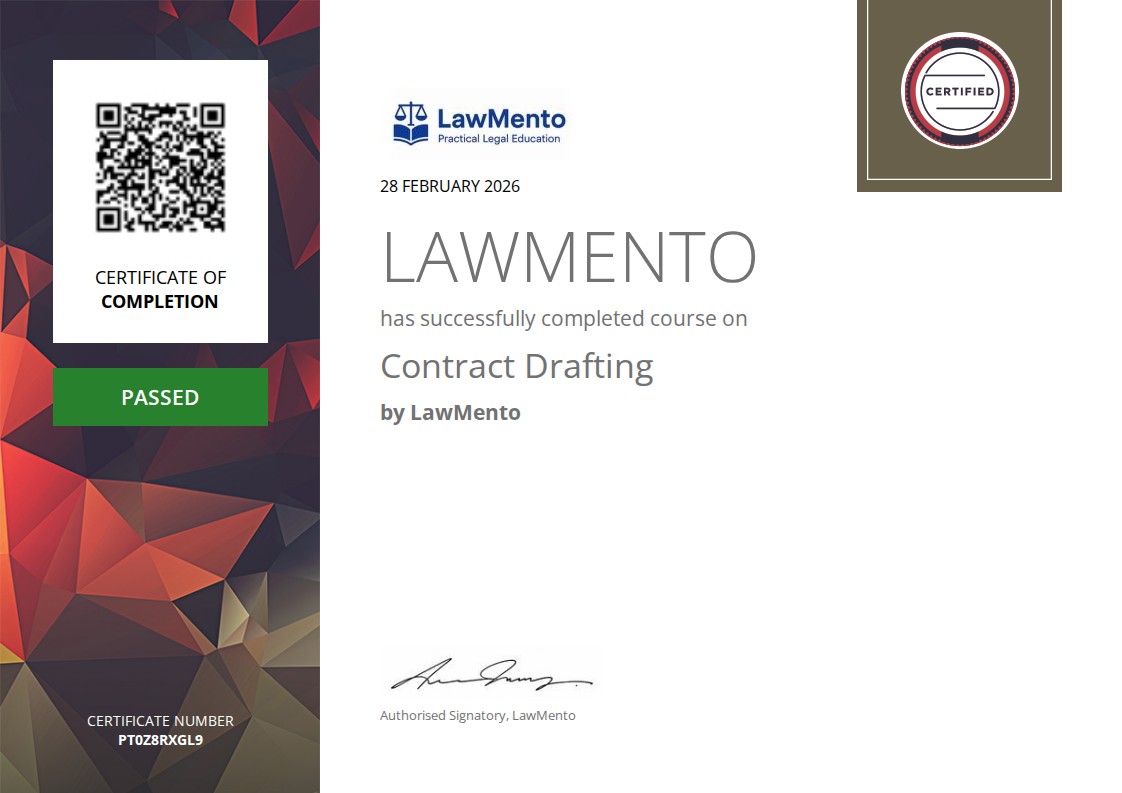
A Verifiable LawMento Certificate
Each LawMento certificate is digitally verifiable through a unique certificate number and QR code. It includes the learner’s name, course title, completion date and authorised signature. The online legal research and writing certificate course therefore provides a verifiable record of completion.
Start Learning for ₹1,099
Get 10+ hours of learning, 6+ resources, one-year access, a certificate and the bonus list of 500+ research topics.
Questions About the Course
What is the Legal Research and Writing Using AI course?
It is an online legal research and writing certificate course covering research methods, case-law searches, legal platforms, writing structure, citations, dissertations, publishing and responsible AI use.
Who can enrol in the course?
Undergraduate and postgraduate law students, recent graduates, lawyers, advocates, researchers, legal content writers and others interested in strengthening legal research and writing skills may enrol.
Is the course suitable for beginners?
Yes. It begins with foundational concepts and gradually moves towards practical research, writing, citations and AI-assisted methods.
Is prior knowledge of AI required?
No advanced technical knowledge is required. The course focuses on practical use, verification, accuracy and ethical limits.
Does the course include practical legal research?
Yes. It includes guidance on Indian Kanoon, Digital Supreme Court Reports, Law Commission reports, structured Google searches and citation-based case-law searches.
Does the course cover citations and references?
Yes. A dedicated module explains references, citations, footnotes and bibliographies, including the need to verify AI-generated citations.
Will the course help with research papers and dissertations?
The course covers research-paper structure, thesis and dissertation planning, literature review, methodology, chapter planning, editing and referencing.
Can AI replace traditional legal research?
No. AI cannot replace judgments, statutes, official sources or independent legal reasoning. It is presented only as a supporting tool.
How long is course access available?
Learners receive access to the course for one year.
Will I receive a certificate?
Yes. Learners receive a certificate of completion after completing the course requirements.
When will I receive access?
Course access is provided immediately after successful payment. Check the registered email address for access details.
Does the course guarantee publication or employment?
No. The course provides structured skill development but does not guarantee publication, employment, internships, assignments or income.