
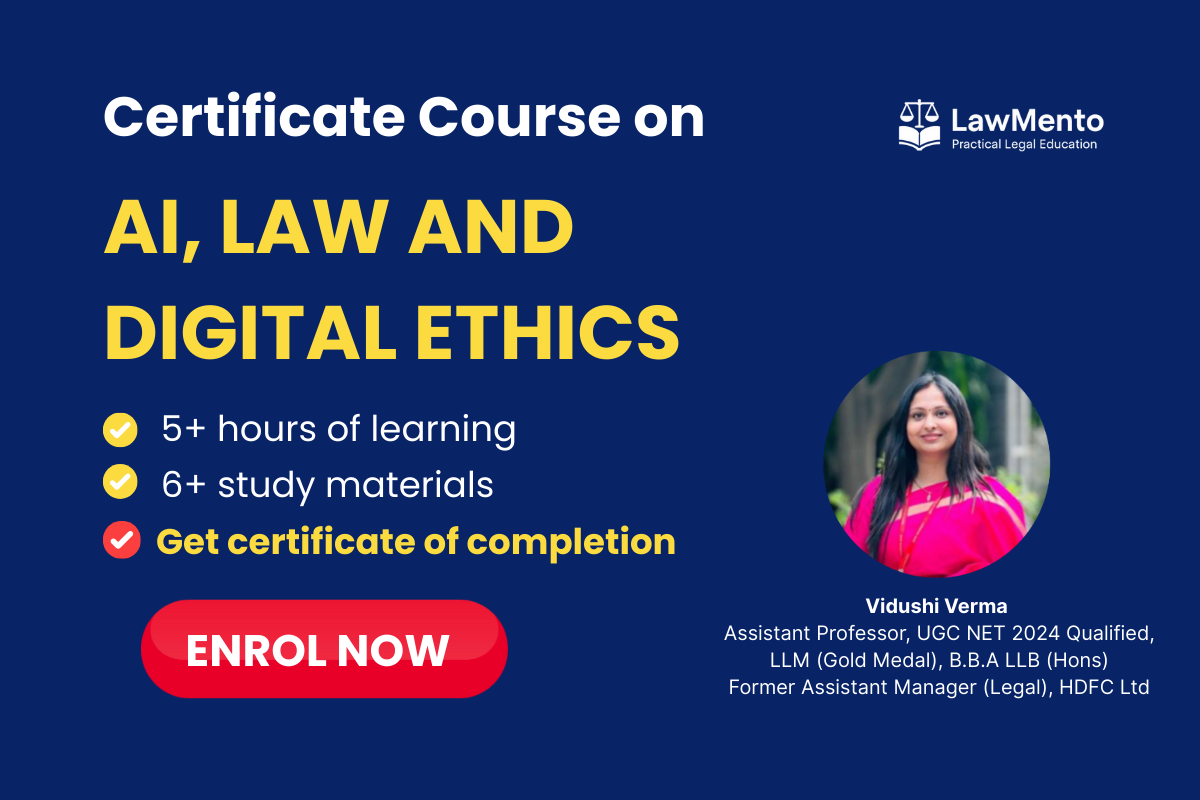
Online Certificate Course on AI and Law
Understand how artificial intelligence is transforming law, rights, courts, regulation and legal practice through 5+ hours of structured learning, 7 focused modules, 6+ reading resources and a certificate of completion.
About the Online Certificate Course on Artificial Intelligence and Law
Artificial intelligence is reshaping legal research, drafting, litigation analysis, dispute resolution, governance and regulatory compliance.
This AI and law online course explains how artificial intelligence interacts with Indian law, constitutional rights, data protection, intellectual property, courts and digital ethics.
The course examines the use of AI in law schools, law firms, courts, online dispute resolution and administrative systems. It also discusses privacy, surveillance, algorithmic bias, freedom of speech, copyright, patents and human-rights concerns.
Designed as a practical introduction, this artificial intelligence law course helps learners understand both the opportunities and limitations of AI in legal education and professional practice.
Key AI and Law Issues This Course Examines
- Use of AI in legal research, drafting and litigation analysis
- AI regulation and policy frameworks in India
- Privacy, surveillance and fundamental-rights concerns
- Algorithmic bias and discrimination
- Copyright and patent issues involving AI
- Ethical limits of AI in legal decision-making
Understand the Legal Impact of Artificial Intelligence
Study Indian regulation, constitutional safeguards, intellectual property, privacy and digital ethics in one structured course.
Skills Learners Can Develop
The course develops a structured understanding of how AI is used, regulated and questioned across legal systems.
Understand AI Fundamentals
Build clarity on artificial intelligence, common legal use cases and the role of AI tools in modern legal work.
Apply Indian Legal Frameworks
Connect the IT Act, data-protection law, sectoral regulation and policy documents to AI-related legal issues.
Analyse AI in Courts
Examine eCourts, SUPACE, predictive analysis, online dispute resolution and administrative applications.
Evaluate Fundamental Rights
Study privacy, freedom of expression, surveillance, discrimination and constitutional safeguards.
Identify IP Issues
Understand copyright, patents, databases, trade secrets and AI-generated or AI-assisted works.
Assess Algorithmic Bias
Recognise fairness, transparency and discrimination concerns in automated decision-making.
Examine Digital Ethics
Explore ethical AI principles, human-rights standards and responsible use in legal settings.
Understand Professional Scope
See how AI knowledge supports work in litigation, compliance, technology law, policy and legal education.
Designed for Law Students and Legal Professionals
Law Students
Useful for students seeking a clear introduction to AI, technology law, privacy, digital rights and legal innovation.
Recent Law Graduates
Supports graduates preparing for roles where digital regulation and technology awareness are increasingly relevant.
Lawyers and Advocates
Relevant for practitioners dealing with digital evidence, privacy, intellectual property, compliance and AI-related disputes.
Corporate Legal Professionals
Helpful for professionals assessing AI adoption, governance, data use and sector-specific compliance.
Legal Educators and Researchers
Provides a structured base for teaching, research and discussion on artificial intelligence and law.
Anyone Seeking Upskilling
Suitable for learners interested in the legal, constitutional and ethical implications of artificial intelligence.
Study AI Law Through Regulation, Rights and Ethics
Receive structured lessons, practical legal context, reading resources and one-year access.
AI and Law Course Plan
The curriculum moves from AI fundamentals to Indian regulation, courts, fundamental rights, intellectual property and digital ethics.
Module 1: Fundamentals of AI and Law
- What is artificial intelligence?
- Use cases of AI in legal research, drafting, litigation analysis and e-discovery
- AI in law schools and legal education
- AI in courts, smart contracts and online dispute resolution
Module 2: Indian Legal Frameworks for AI
- NITI Aayog’s National Strategy on AI
- Status of AI-specific legislation in India
- IT Act, 2000 and the Digital Personal Data Protection Act, 2023
- Sectoral regulation and soft law involving RBI, SEBI and MeitY
Module 3: AI and the Indian Legal System
- AI in Indian courts, the eCourts Project and SUPACE
- Predictive analysis in litigation and bail decisions
- AI in online dispute resolution
- Use of AI in tribunals and arbitration
Module 4: AI, Privacy and Fundamental Rights
- Right to privacy and Puttaswamy v. Union of India
- AI surveillance and facial-recognition systems
- Algorithmic content moderation and freedom of speech
- Bias, discrimination and safeguards in the Indian context
Module 5: Intellectual Property Issues with AI
- Copyrightability of AI-generated works in India
- Trade secrets, AI models and database protection
- DABUS and its implications
- Patentability of AI inventions
- Copyright challenges in training large AI models
Module 6: AI, Ethics and Human Rights
- Algorithmic bias and fairness
- AI and privacy
- AI and freedom of expression
- Surveillance and predictive policing
- Ethical AI principles from OECD, UNESCO and IEEE
Module 7: Conclusion
- Key legal and ethical takeaways
- Opportunities and limitations of AI in legal practice
- Responsible use of AI by legal professionals
Where AI and Law Knowledge Is Used
Legal Research
AI-assisted search, case analysis, summarisation and legal-information workflows.
Drafting and Review
Use of AI in preparing, reviewing and improving legal documents.
Litigation Analysis
Case strategy, evidence review, e-discovery and predictive tools.
Courts and ODR
Judicial technology, online dispute resolution and administrative systems.
Privacy and Data Protection
AI surveillance, personal data processing and compliance obligations.
Intellectual Property
AI-generated works, model training, patents, databases and trade secrets.
Corporate Compliance
Responsible AI adoption, governance frameworks and sectoral regulation.
Policy and Ethics
Fairness, accountability, human rights and emerging AI regulation.
Meet the Mentor

Adv. Vidushi Verma
Assistant Professor of Law and UGC NET 2024 qualified. She is an LLM Gold Medallist from NLU Odisha with 4+ years of industry experience, including her role as Assistant Manager (Legal) at HDFC Limited. She specialises in regulatory and technology-related legal subjects.
Build Knowledge in AI Regulation and Digital Rights
Learn how artificial intelligence is affecting courts, legal practice, privacy, intellectual property and human rights.
Add a Verifiable LawMento Certificate to Your Profile
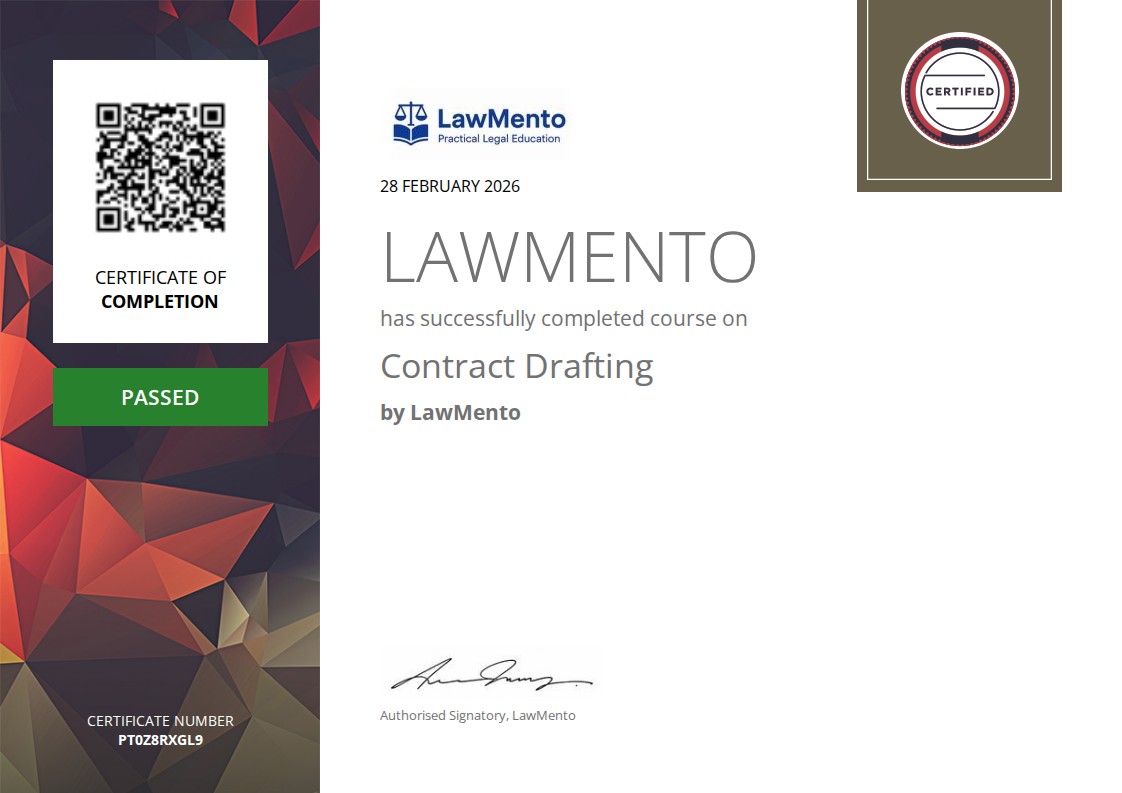
Each LawMento certificate includes the learner’s name, course title, completion date, authorised signature, unique certificate number and QR code. It can be added to a CV, LinkedIn profile or professional portfolio as evidence of continued skill development.
Questions About the AI and Law Course
What is included in the online certificate course on AI and law?
The course includes 5+ hours of structured learning, seven modules, 6+ reading resources, one-year access and a certificate of completion.
Is this AI law course suitable for law students?
Yes. The course is suitable for law students who want to understand artificial intelligence, technology law, privacy, intellectual property and digital ethics.
Can practising lawyers enrol in this artificial intelligence law course?
Yes. Lawyers and advocates can use the course to strengthen their understanding of AI-related regulation, digital disputes, privacy and professional use of AI tools.
Does the AI and law course cover Indian law?
Yes. It covers Indian policy documents, the IT Act, data-protection law, court technology, constitutional rights and sectoral regulatory approaches.
Does the course cover copyright and AI-generated works?
Yes. The curriculum discusses copyright, patents, trade secrets, databases, AI-generated works and model-training issues.
Does the online course on artificial intelligence and law provide a certificate?
Yes. Learners receive a certificate of completion after satisfying the applicable course-completion requirements.
When will course access be provided?
Access is provided immediately after successful payment. Learners should check the email address used during enrolment.
How long will I have access?
The course remains accessible for one year from enrolment.
Start Learning AI and Law
Join the online certificate course on artificial intelligence and law and receive immediate access to the complete curriculum, resources and certificate pathway.